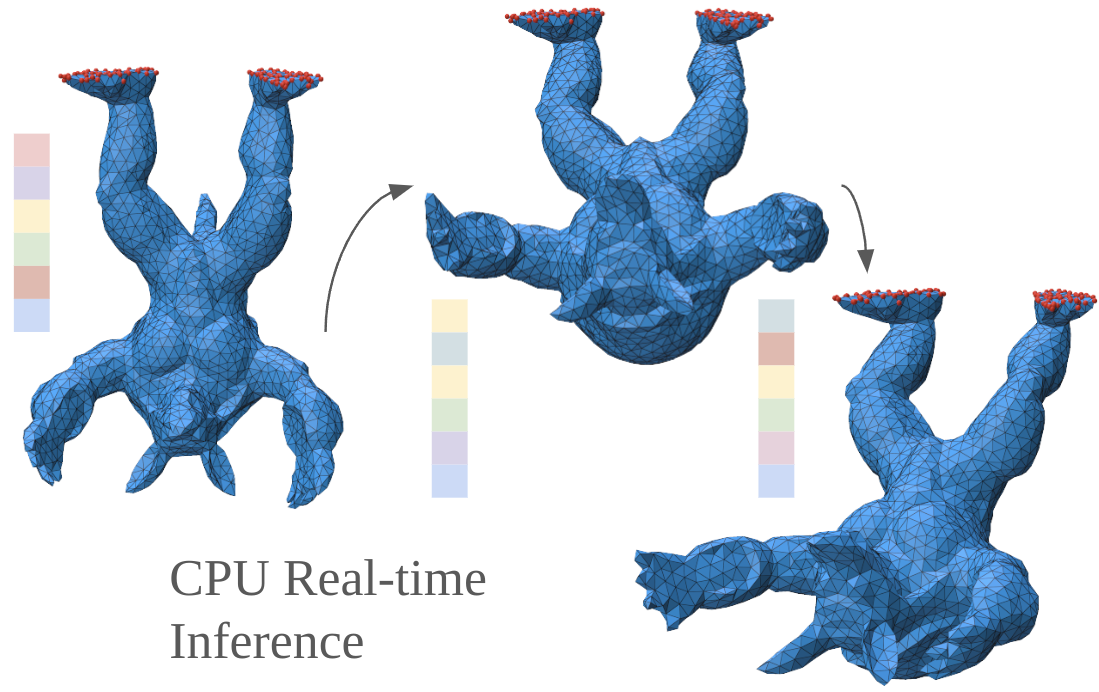
Modeling the dynamic behavior of deformable objects is crucial for creating realistic digital worlds. While conventional simulations produce high-quality motions, their computational costs are often prohibitive. Subspace simulation techniques address this challenge by restricting deformations to a lower-dimensional space, improving performance while maintaining visually compelling results. However, even subspace methods struggle to meet the stringent performance demands of portable devices such as virtual reality headsets and mobile platforms. To overcome this limitation, we introduce a novel subspace simulation framework powered by a neural latent-space integrator. Our approach leverages self-supervised learning to enhance inference stability and generalization. By operating entirely within latent space, our method eliminates the need for full-space computations, resulting in a highly efficient method well-suited for deployment on portable devices. We demonstrate the effectiveness of our approach on challenging examples involving rods, shells, and solids, showcasing its versatility and potential for widespread adoption.
| Paper | |
| Project Page | ACM |
| Video | YouTube |
| arXiv | 2507.07440 |
BibTeX
@article{li2025latentdynamics,
  title = {
    Self-supervised Learning of Latent Space Dynamics
  },
  author = {
    Li, Yue and
    Lin, Gene Wei-Chin and
    Larionov, Egor and
    Bozic, Aljaz and
    Roble, Doug and
    Kavan, Ladislav and
    Coros, Stelian and
    Thomaszewski, Bernhard and
    Stuyck, Tuur and
    Chen, Hsiao-yu
  },
  year = {2025},
  issue_date = {August 2025},
  publisher = {Association for Computing Machinery},
  address = {New York, NY, USA},
  volume = {8},
  number = {4},
  issn = {2577-6193},
  url = {https://doi.org/10.1145/3747854},
  doi = {10.1145/3747854},
  journal = {Proc. ACM Comput. Graph. Interact. Tech.},
  month = aug,
  articleno = {57},
  pages = {1--18},
  numpages = {18},
  eprint = {2507.07440},
  archivePrefix = {arXiv},
  primaryClass = {cs.GR}
}